When Kalani Hobayan, Elementary Physical Education Teacher at Pomona Unified School District and Part-Time Lecturer in the Kinesiology Department at Cal State Fullerton, walked into a session at the 2023 California Association for Health, Physical Education, Recreation and Dance’s (CAHPERD) Conference in Santa Clara, California, he didn’t know exactly what technology or tool he was looking for.
But he knew he was looking for a way to bring his elementary physical education department back to life after the COVID pandemic.
Three years, one doctoral dissertation, and a district-wide rollout later, Hobayan was named the CAHPERD Elementary Physical Education Teacher of the Year for 2025-2026, and the heart rate data behind his success is headed for publication.
Keep reading to discover how this award-winning PE teacher closed the physical education activity divide in his district’s lower-income communities and helped elementary students reach 58.2% average class time in moderate-to-vigorous physical activity (MVPA) districtwide.
From a Conference Session to a District-Wide Rollout
Hobayan went to the 2023 CAHPERD Conference representing Pomona Unified’s elementary PE department, searching for a way to reengage students who had spent much of the previous two years learning from home and living a more sedentary lifestyle.
Like PE teachers mostly everywhere, Hobayan had spent the pandemic trying to get students moving while only communicating through a computer screen. Unfortunately, without any tools to help measure students’ activity, there wasn’t reliable student accountability in virtual PE. Hobayan had no way to know if the students were doing their work or not.
“Virtual PE classes were spaces to check in with kids and just try to get them moving,” he said. “Getting students to actively engage was probably one of the hardest tasks. I know a lot of PE teachers struggled with it.”
After he sat in on a CAHPERD Conference session demonstrating IHT’s student heart rate monitors, the direction of his career changed.
“After I got done with that session, I was hooked on it,” Hobayan said. “Being able to see that feedback off the watch was very impactful for me.”
He brought the idea back to his department, got the support of District PE Teacher Specialist Michelle Baumgartner, wrote a funding proposal, and secured buy-in from his director and assistant superintendent. Pomona Unified had money left over from a state funding initiative, so what started as a proposed 10-school pilot expanded into a plan to eventually outfit every elementary site in the district with IHT heart rate monitors.
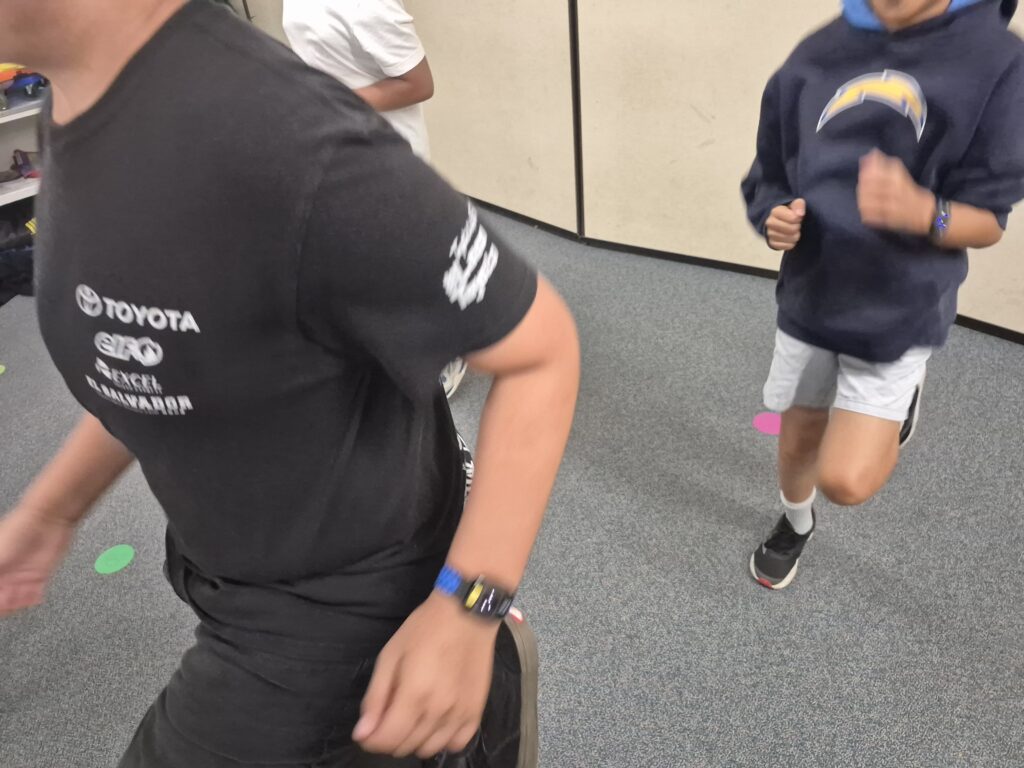
The rollout started small and built momentum quickly. Hobayan piloted IHT’s heart rate monitors at Pantera Elementary in September 2024, working out the logistics before bringing the program to the rest of his department. By mid-November, 10 elementary schools were using the monitors.
“It provided an accountability piece for students,” Hobayan said.
By January 2025, that number had grown to 14 schools. By the start of Pomona’s 2025/2026 school year, nearly all 24 of the district’s elementary schools were using IHT’s heart rate monitors, with expansion soon following into moderate-to-severe special education classes, four middle schools, and four high schools.
Learn more about our heart rate monitors.
Turning Minutes Into Motivation
For Hobayan, adopting the IHT system was only half the equation. Getting students and teachers to actually care and buy into the heart rate data collected in the Spirit System Software Suite was the other crucial half. And that’s where the district got creative.
Pomona Unified built a rewards structure around the numbers the heart rate monitors for schools were producing:
- Monthly department awards for the students logging the most active minutes
- An IHT MVPA Trophy for whichever school posted the highest MVPA percentage that month
- District-level recognitions at the end of the year
“It became a very big competition,” Hobayan said. “It really took off for the intrinsic motivation for students. Not only for the awards, but they became very aware of what the watch is and what the percentage is and how many minutes they had. And that was one of our biggest goals that we had in our department.”
PE teachers in the department, who Hobayan describes as naturally competitive, turned the rollout into a friendly competition among the district’s schools. And that rivalry produced one of Hobayan’s most memorable moments with the program.
“I was teaching a fourth grade class, and they hit over a thousand minutes in one class session,” Hobayan said.
Fellow PE teacher Jordan Hurtado, a former student of Hobayan’s at Cal State Fullerton, later beat that number with 1,200 minutes in one of his own classes. For Hobayan, the competitive back-and-forth wasn’t really about the leaderboard. It was proof that students were motivated and taking ownership of their movement in class.
That growth showed up in the data immediately. In the 2024-25 school year, with roughly 3,800 fourth, fifth, and sixth grade students wearing IHT’s heart rate monitors for their twice-weekly PE classes, Pomona Unified’s elementary PE classes averaged 55.6% of class time in MVPA in their first year of the program, nearly 25% higher than the national average of 44.8% and well above the CDC’s 50% recommendation.
That momentum continued as adoption expanded. In the 2025–26 school year, with all 18 PE teachers in all 24 elementary schools across the district using the Spirit System, the elementary PE classes averaged 58.2% time in MVPA – more time than the year prior.
The heart rate monitors were truly increasing motivation and participation in PE, and PUSD had the data to prove it.
Michelle Baumgartner, the district’s Physical Education Specialist who championed the program’s expansion, saw that motivational shift show up in her teachers’ classrooms in ways the numbers alone couldn’t capture.
“IHT is beneficial for any school district,” she said. “It will definitely give your students motivation to do better in PE but also to reach their own personal fitness goals. There was a girl in fifth grade who was using the heart rate monitor at Pantera, and she says [to me], ‘Are we keeping these heart rate monitors? Because I really like them.’”
It was that kind of enthusiasm, multiplied across thousands of students in a single school year, that set the stage for what Hobayan would build next.
Read more about Pomona’s 25% increase in student MVPA.
The Data Behind a Doctoral Dissertation
Hobayan’s success in the classroom eventually became the foundation for his doctoral research. This past spring, he completed his Educational Doctorate at California State University, Fullerton, with a dissertation titled “Improving MVPA Levels in Disadvantaged School Settings Through the Use of Heart Rate Monitors in Physical Education.”
The research grew out of a pattern Hobayan calls the “PE activity divide”: unequal access to quality physical education in lower socioeconomic communities. His review of existing research found that schools in lower-SES areas logged close to 15 fewer minutes of MVPA than schools in higher-income districts.
Hobayan wanted to know whether Pomona Unified, a Title 1 district serving a large lower-income student population, fit that pattern or whether heart rate monitors and the data it provided could help the district overcome it.
“There’s kind of unequal access to quality physical education programs,” Hobayan said. “It is our job to ensure all students gain genuine and authentic learning experiences.”
Hobayan ran his study across 10 elementary schools from December to February, with seven PE teachers volunteering to participate. Teachers tracked their classes’ progress against the CDC’s recommendation that students spend at least 50% of PE class time in MVPA, using biweekly logs and weekly PLC discussions to review the data and adjust lesson plans on the fly.
Because Hobayan’s study required parental consent and student assent forms for participation, his research sample dropped to a final study group of 291 4th-6th graders.
Over the 10-week study, that group of students spent an average of 62.62% of PE class time in MVPA zones, well above the CDC’s 50% recommendation. Boys averaged 63.8% and girls averaged 61%. Broken down by age, 9-year-olds averaged 63%, 10-year-olds averaged 60%, 11-year-olds averaged 62%, and 12-year-olds posted the highest average at 64%.
Zooming out from the 291-student study sample to the entire class rosters of the seven participating teachers, the average MVPA percentage was 57.45%, still comfortably above the CDC benchmark.
The heart rate data not only measured MVPA, it also gave students and educators real-time visibility, which actively shaped how teachers taught and increased student motivation and accountability in PE. That biweekly log-and-PLC cycle turned PE planning into an ongoing feedback loop instead of guesswork, and it’s a big part of why the study group came in nearly 13 points above the CDC’s 50% MVPA benchmark.
“While individual accolades highlight my success in the PE field, the true reward is what the heart rate monitors have provided our students: meaningful, engaging, and authentic experiences in physical education,” Hobayan said. “I wouldn’t have a dissertation idea if I didn’t have [IHT]. If you ask me why I won that award, it’s because of what the heart rate monitors provided for students.”
Get your own custom quote for IHT heart rate monitors.
District-Wide Results & California Elementary PE Teacher of the Year

Pomona district’s broader numbers tell an even bigger story. Across an entire school year, all 18 elementary PE teachers using IHT heart rate monitors at Pomona Unified posted an average MVPA percentage of 58.2%, once again outperforming the CDC’s recommendation. Combined, their students in 4th-6th grade logged 1,454,191 minutes of MVPA over the course of the 2025-2026 school year, a figure Hobayan shared directly with district leadership.
Those numbers speak directly to the PE activity divide Hobayan identified in his dissertation research: the pattern of lower-income districts falling behind their higher-income counterparts on physical activity. Prior research he referenced found middle school PE classes averaging around 48% MVPA.
When Hobayan applied the same heart rate monitor data to his own middle school PE classes, Pomona’s students came in at 52%, outperforming that outside benchmark in a setting where engagement typically drops as students get older.
“I think our district kind of went against the norm,” Hobayan said. “We’re well above that. We’re moving and want to keep moving in the right direction regarding meaningful movement experiences for our students.”
For a district serving a large population of lower-income students, a result like that isn’t just a good number. It’s evidence that the PE activity divide Hobayan set out to study doesn’t have to be permanent.
The impact extended beyond typical PE classes, too. Two PE teachers assigned to moderate-to-severe special education classes began using our monitors with their students, and those students went on to place in the top 10 for MVPA district-level awards.
Encouraged by results like these, district and secondary leadership pushed to expand the program into four middle schools and four high schools starting in January 2026, and Pomona Unified is now planning family fitness nights, where parents will wear the monitors alongside their kids and experience a PE class firsthand.
The recognition kept building. In January 2026, CAHPERD named Hobayan its Elementary Physical Education Teacher of the Year for 2025-2026, an honor he credits directly to the program he helped build.
“The heart rate monitors, our department, and teachers that bought into the MVPA vision, along with the backbone and support of IHT, played a major role in creating meaningful and engaging experiences for our students,” Hobayan said. “The heart rate monitors, having the backbone and the support of IHT is one of the big contributors to why I won that award.”
District leadership took notice, too. According to Hobayan, sharing the MVPA data with his director and assistant superintendent helped elevate physical education within the district’s broader priorities and encouraged the expansion into secondary schools that followed.
Hobayan is currently in the process of publishing his dissertation, which will give other school districts and colleagues in the field a data-backed roadmap for closing their own PE activity divide, and he regularly fields requests from PE teachers and administrators across California who want to see the IHT heart rate monitors in action.
With IHT Monitors, You Could Be Your School’s Hero, Too
Hobayan’s advice to other PE teachers and administrators considering heart rate technology is simple: don’t assume the work is ever finished.
“Something can be good, but can always be done better,” Hobayan said. “That’s where that growth mindset is. Even when you feel confident in your approach, the PE environment is constantly evolving, and each group of students may learn, respond, and take away something different from the experience. So, always being able to adapt and learn different things, I think is one of the biggest attributes in the teaching profession.”
That growth mindset extends to how Hobayan talks about IHT.
“I would just say that the partnership with IHT has been probably one of the biggest positive attributes to help transform a quality physical education program,” Hobayan said. “I can’t thank IHT enough because they did a lot for me.”
Hobayan’s dissertation adds academic weight to something PE teachers have long known instinctively: the right tool, placed in the right hands, can help close persistent equity gaps in student wellness.
Pomona Unified’s PE program is now setting a pace other school districts are working to match, and the path to get there isn’t a mystery. Any district with access to the Spirit System has what it takes to close its own PE activity divide and boost students’ MVPA.