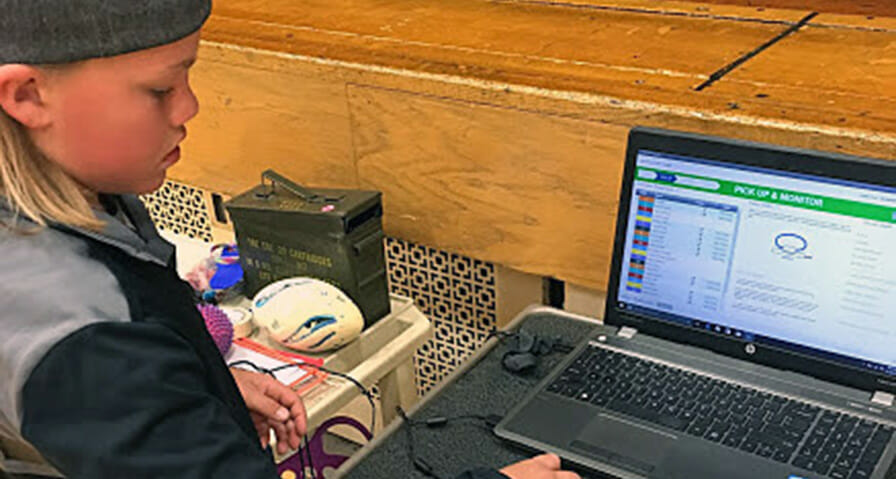
IHT’s fitness tracking goes in tandem with curriculum called PE3, or “PE for the Mind, Body, Spirit,” that teaches students about things like healthy eating, how feelings impact our food or exercise, and how and why to measure your pulse rate. The Texas Education Agency awarded the program as an official PE course for every high school, and it also received honors from the Texas Department of State Health Services as the most effective curriculum in 2011.Worksheets and journaling exercises accompany the program, including vision boards, weekend family activities, and mood recognition. The curriculum was developed for high school and middle school students, but IHT is expanding the program in the fall to include elementary school. Below is an example of one worksheet exercise.Kreatsoulas said that approaching fitness by learning how exercise makes you feel rather than how successful your wearable says you are is a healthier strategy.”My fear about having trackers in school is that it’s going to strip children of their right to be children, to just play. And to not be so hyper-vigilant about their performance,” she said. “I think, for people with that setup for an eating disorder, becoming so in-tune to performance at such a young age, I think it will just kick in as an eating disorder much sooner than maybe if there wasn’t such a hyper-vigilance about performance.”Almost one in 60 kids between ages 13 and 18 would qualify for an eating disorder, according to a study from researchers from National Institute of Mental Health (NIMH), the Universities of Chicago and Minnesota, and the National Center for Scientific Research in Bordeaux, France.
Ohlson said that PE teachers can use the heart rate and activity data to recognize over-exercising and talk to kids about healthy behavior, and help teachers keep track of classes with upwards of 100 students. However, a lot of behaviors that signal disordered eating happen outside the classroom.
Clinical psychologist Dr. Lynn Tracy equates in-school fitness tracking with programs like weigh-ins or BMI report cards. In 2014, these report cards were distributed to schoolchildren in New York, despite BMI being an unreliable indicator of children’s health. Critics decried the report cards as “fat-shaming,” and the Academy for Eating Disorders called upon the New York Department of Education to stop the practice.
The affects of fitness tracking on both physical and mental health of students is not well-known, and it’s unclear what sort of impact long term health tracking has on childhood development.