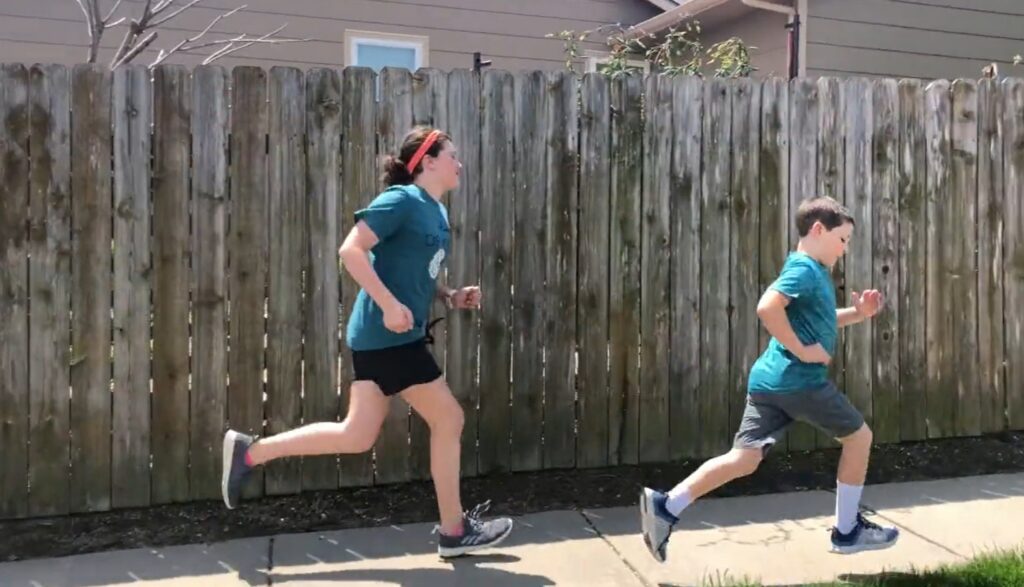
When a Zoom meeting room takes place of the gym, accountability can feel like the first thing to disappear. But for virtual PE teachers, the primary challenge isn’t just getting students moving at home – it’s finding meaningful, reliable ways to track participation, progress, and student wellness from miles away.
How do you hold students accountable for physical activity when you can’t see them? How do you track virtual PE students across dozens of home environments, schedules, and fitness levels … and still deliver a program that meets rigorous academic standards?
This is the central problem of virtual PE accountability, and it’s one that traditional tools (such as honor-system activity logs, screenshot submissions, or step counters) simply cannot solve. Students are left without meaningful feedback. Teachers are left without verifiable data. And virtual PE programs are left vulnerable when administrators ask for evidence or data.
The good news is that many schools across the country have solved this problem.
The solution? Their virtual PE students use wearable student heart rate monitors paired with purpose-built software to track students remotely with better objectivity and insight than an in-person PE teacher can administer with the naked eye. Keep reading to learn more about what this type of remote PE program looks like and why it works.
The Core Challenge With Virtual PE Accountability
Teaching remote PE without objective data is like grading an essay you’ve never read. You’re trusting students to self-report, self-assess, and self-motivate – three things that are difficult for adults, let alone students managing full academic loads at home.
Tammy Claussen, a PE teacher at Leland and Gray Union High School in Townshend, Vermont, experienced this frustration firsthand when her school shifted to an online model.
“We needed a way to hold kids accountable in PE,” she said. “I’d been using [other] heart rate monitors for 20 years, but the thing that brought me to IHT is the data. This was important to me because there is no other device like it designed for education. I really appreciate that. The evidence [of student performance] could come right to me virtually. This was huge.”
Without that data flowing directly to the teacher, virtual PE accountability collapses into guesswork. Teachers can’t track virtual PE students meaningfully, can’t identify who’s struggling, and can’t provide feedback grounded in reality. If that’s the case, then what’s even the point of the PE class?
Requirements to Track Students Remotely
To track students remotely in a way that holds up academically and administratively, a virtual PE program needs three things:
- Objective, tamper-proof data about student activity
- Visibility for the teacher into every student’s performance
- Structured feedback loops that connect student data to teacher response
Wearable heart rate monitors for schools address all three. The IHT Spirit System was designed specifically for this context – not as a consumer fitness tracker adapted for school use, but as an education tool built for schools to solve the accountability problem from the ground up.
Here’s how it works in a remote PE environment:
- Students wear the Spirit Heart Rate Monitor during their activity.
- The monitor connects to the Spirit Individual app on their mobile device (iOS or Android phones or tablets) or Chromebook.
- The students’ data syncs directly into the Spirit Software’s teacher account.
- The data arrives automatically, organized by student, session, and heart rate zone.
Heart Rate Zones: The Language of Remote PE Accountability
One of the most powerful features the Spirit System has for virtual PE programs is its color-coded heart rate zone framework that displays in real-time to the students (and is tracked inside software for educators). The system categorizes student effort into three heart rate zones:
- Blue = low intensity / rest
- Yellow = moderate intensity exercise
- Red = high or vigorous intensity exercise
This framework does two critical things when you’re trying to track virtual PE students. First, it gives students a concrete, visual way to understand their own effort in real time. Second, it gives teachers a standardized, objective lens for evaluating that effort across every student, regardless of their location, fitness level, or activity choice: heart rate.
When teachers can see every student’s heart rate zone breakdown for every session, they have the evidence they need to grade fairly, intervene early, and demonstrate program quality to administrators.
How Prince William County Schools Tracks 300 Students Remotely
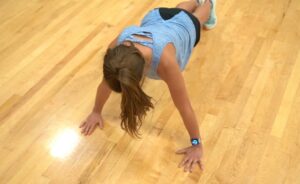
One of the largest and most successful examples of using IHT to track students remotely comes from Prince William County Public Schools in Virginia, where Virtual PE Supervisor Brett Helman oversees a program that serves up to 300 students every term.
The program is built on the firm expectation that every student must use an IHT heart rate monitor and IHT Spirit Individual App, regardless of whether they own their own fitness tracker. That requirement isn’t arbitrary. It makes virtual PE accountability possible at scale.
“We were looking for something that holds both the student and teacher accountable, and IHT gives us that aspect,” Helman said. “And what I mean by that is it has allowed us to see the progress that students are making.”
The alternative (allowing students to use their own devices and submit data in whatever format they choose) was clearly not desirable. Helman had seen how that played out at other programs.
“We talked to some programs where they let students use whatever [device] they have,” he said. “But then, the teacher can’t see or have access to that [data]. They’re just telling students ‘you need to do this,’ and they hope at the end of the two weeks, that’s what the student turns in.”
The difference between that model and our model is the difference between hoping and knowing. Helman explained: “The most valuable part of IHT is the ability for instructors and teachers to monitor their student’s progress towards physical fitness hours all in one location using the IHT assessment software.”
With all student data centralized, virtual PE teachers can track their remote students efficiently and take action quickly when someone falls behind.
“We can say, ‘hey, you’re a little bit behind on your minutes,’ or ‘hey, I see your workouts and a lot of them have been in the blue range,” Helman said. “‘Here are some workouts that you can try that will elevate your heart rate into those yellow and red ranges so you can get more minutes in that range.’”
This is how virtual PE teachers can truly impact their students’ lives and improve their health and fitness journeys.
This kind of specific, data-backed feedback is only possible when you have a system designed to track students remotely with precision. And it’s what separates a rigorous online PE course from one that simply hopes students are staying active.
Why Letting Remote PE Students Use Any Device Doesn’t Work
It’s a common compromise: let students use whatever fitness tracker they already own and have them submit screenshots or exports at the end of the week.
It sounds reasonable. But it doesn’t work.
The problem isn’t the hardware. The problem is that without a unified platform, teachers can’t track virtual PE students in a consistent way. Every student is submitting data in a different format, from a different source, with different levels of accuracy. There’s no standardized heart rate zone framework. There’s no automatic data delivery to the teacher. And there’s no way to know whether the data reflects actual student effort or a watch left on a desk.
Claussen experienced this problem with free apps before she found IHT.
“We’d ask students to download free apps so they could send us proof of a workout and they wouldn’t use the app,” she said. “With IHT, we could get a heart rate monitor in everyone’s hands and students can use them with their Chromebooks. That levels the field for everyone.”
Leveling the field is the key phrase. When every student uses the same monitor and the same app, the teacher gets comparable data across the entire class. Remote PE stops being a patchwork of self-reported information and becomes a real, auditable program.
What the Data Looks Like After Every Session
After each workout, the Spirit System delivers a layered set of data to the student, to the teacher, and to the student’s parents.
For the student: An immediate session summary on their device showing total minutes of exercise, minutes spent at moderate or vigorous intensity (MVPA), and time in each heart rate zone for the activity and the current week. Students also receive an email with a heart rate graph covering the full session and a progress report toward their daily or weekly goals.
For the teacher: A centralized dashboard where every student’s session data is available immediately. The Spirit Software allows the teacher to view individual sessions, generate progress reports over any time period, and identify patterns, such as who’s consistently in the blue zone, who’s hitting their MVPA targets, who hasn’t logged a session in several days.
Teachers who use the Spirit System consistently find that seeing the data changes how students think about effort. Caitlin Schoville, Health and Physical Education Teacher at Pleasant Valley Junior High in Iowa (and a SHAPE America Central District Middle School PE Teacher of the Year) explained: “Students can see and associate their level of effort and rate of perceived exertion compared to what their heart is actually doing. We wanted students to know and understand that visually watching someone participate does not show or tell you their cardiovascular health.”
That real-time feedback loop is especially important in a virtual setting, where there’s no teacher physically present to encourage students. The monitor and the app become the pivotal feedback mechanism that keeps students engaged and honest.
Virtual PE Accountability Supports Student Choice Without Sacrificing Standards
One of the most compelling aspects of using the Spirit System to track students remotely is that it enables genuine student choice without undermining academic rigor. Students in a virtual PE program can choose their own activities – such as running, yoga, basketball, cycling – and the monitor captures their heart rate data regardless of what they’re doing.
This is a significant upgrade from both traditional PE (where the teacher sets every activity) and from self-reported virtual PE (where students can claim they did anything).
With IHT’s technology, heart rate data levels the playing field across every activity a student might choose.
“A student who is walking a lap on a track may be in the MVPA zone, while another student is running the lap but is barely into their yellow/MVPA zone,” Schoville said. “Without knowing, the walker may look like they are slacking or lack of participation, when in reality, they are working at a higher level than the person who ran a lap.”
That same principle applies directly to virtual PE. Without objective data, effort is invisible, and “vigorous exercise” is just a hope. With heart rate data, it’s a measurable standard. Teachers can require a certain number of MVPA minutes per week, and the Spirit System tracks whether students are hitting that threshold, regardless of what activity they’re doing or where they’re doing it.
This is one of the most underrated benefits of heart rate-based virtual PE: it teaches students what moderate and vigorous effort actually feels like in their own bodies, not as an abstract definition, but as a lived experience they can recognize and repeat. And because the Spirit System lets students choose their own activity, they’re building that awareness through movement that fits their real lives.
That autonomy matters.
When students have ownership over how they move, they’re more likely to push harder, stay consistent, and carry those habits well beyond the school day. With a clear MVPA benchmark in place, that self-directed effort has a measurable target.
Helman’s program at Virtual Prince William sets a specific benchmark that students must accumulate an average of 20–30 minutes of MVPA every day.
“[IHT] provides an option for our instructors and teachers to have all the student data in one location,” Helman said. “With other options, such as Polar, Garmin, etc., teachers would have to go student to student to assess their progress. The assessment software allows the teacher to manage time and provide feedback more effectively.”
The Case for the Spirit System in Virtual PE
The virtual PE programs with the strongest accountability aren’t the ones that give students a choice of tools … they’re the ones that require an IHT heart rate monitor and app for everyone. Helman acknowledged the tradeoff directly.
“Speaking as the person who hands out the monitors at the beginning of the term, would it be easier to just let them use what they have?” he asked. “In certain aspects, yes, but then we lose that ability, we lose that effectiveness, which I think makes our courses very efficient and more personable.”
The word “personable” is worth noting. When teachers can track virtual PE students with precision, they can also respond with precision. They can provide specific feedback and personalized instruction to each student that feels personal and relevant, not generic. That’s what keeps students engaged in a program they’re doing alone at home.
Marty Testo, Leland and Gray Athletic Director, saw the same potential when he contributed budget funds to help Claussen’s program get off the ground.
“Teaching PE remotely, it’s difficult to see the evidence that we need to see,” he said. “This is great because it gives a way to find that proof and get kids accustomed to tracking their own success.”
There’s an obvious reason why educators choose the Spirit monitor again and again and again.
💰 Concerned about costs? Learn more about helpful funding strategies for edtech that truly work.
Ready to Track Your Virtual PE Students With Real Data?
If your virtual or remote PE program is still relying on self-reported logs, screenshot submissions, or a mix of student-owned devices, there’s a much better way. IHT’s Spirit System was built specifically to make virtual PE accountability real, giving teachers the data they need to track students remotely, grade with confidence, and demonstrate program effectiveness to administrators.
Tons of virtual PE programs across the country have made the switch. They’re tracking hundreds of students remotely with the same precision available in any in-person gym class. Their students are more accountable, more motivated, and better equipped to understand their own fitness.
If you’re a virtual PE teacher, PE coordinator, or district administrator ready to build a stronger remote PE program, we’d love to show you how the Spirit System can improve your program.