A student’s fists clench. Their breathing quickens. Their voice gets louder.
By the time a teacher notices any of this, the moment has usually already tipped past the point where a calming strategy will help. Self-regulation, by definition, has to start before the visible signs do, which is exactly why it’s so hard to teach, and can be even harder to measure for an IEP (Individualized Education Program).
How do you measure something that happens inside a student’s body before anyone else can see it? That’s the challenge behind self-regulation IEP goals, and it’s one a lot of special education teams solve with careful observation.
But an IEP goal is only as strong as the data behind it. Heart rate data changes that.
Heart rate monitors give educators objective, physiological data to support self-regulation IEP goals, replacing subjective observation with measurable evidence of a student’s emotional and physical state throughout the day. By connecting heart rate patterns to specific moments, students and educators gain a shared, concrete tool for linking emotions to what’s happening in the body, rather than relying on guesswork after the fact.
Keep reading to find 15 self-regulation IEP goals you can adapt for your own students, organized by category, along with a practical look at how to actually collect defensible progress data for them, as well as how heart rate monitor technology can be used to support students and IEPs.
What Makes a Strong Self-Regulation IEP Goal?
Before diving into examples, it helps to know what separates a workable goal from a vague one. The best self-regulation IEP goals share a few traits:
- They’re observable. Someone other than the student’s own teacher should be able to read the goal and know exactly what to look for.
- They’re measurable. A goal needs a number, a frequency, or a clear threshold attached to it, not just a direction.
- They’re individualized. A goal written for a student with sensory processing differences should look different from one written for a student working through anger management.
- They include a condition. Good goals specify when and where the behavior should occur: during transitions, in the classroom, during unstructured time, etc.
With that framework in mind, here are 15 self-regulation IEP goals examples.
Examples of Self-Regulation IEP Goals:
Emotional Self-Regulation IEP Goals
- Given a visual emotion scale, the student will identify their current emotional state at three checkpoints throughout the school day with 100% completion, as measured by teacher observation, across four consecutive weeks.
- When feeling frustrated during independent work, the student will use a pre-taught calming strategy (deep breathing, counting, or a break card) within 60 seconds of the trigger, in 4 out of 5 observed opportunities.
- The student will verbally or visually communicate feeling “overwhelmed” or “escalated” to an adult before reaching a behavioral crisis point, in at least 3 out of 4 documented instances per week.
- Given a heightened emotional state, the student will independently move to a designated calm-down area and return to baseline within 5 minutes, in 4 out of 5 opportunities.
Anger Management IEP Goals
- When presented with a frustrating task or peer conflict, the student will use words instead of physical actions to express anger in 4 out of 5 observed instances across a grading period.
- The student will identify two physical warning signs of rising anger (e.g., clenched fists, faster breathing) and name them to an adult or on a self-monitoring sheet with 80% accuracy over four consecutive weeks.
- Given a conflict with a peer, the student will request adult support or use a coping strategy instead of an aggressive response in 4 out of 5 opportunities, as measured by behavior logs.
Behavior IEP Goals Examples
- During whole-group instruction, the student will remain in their designated area for at least 15 consecutive minutes without a physical or verbal disruption, in 4 out of 5 observed sessions.
- Given a transition warning (verbal or visual), the student will transition between activities within 2 minutes without a behavioral incident, in 8 out of 10 opportunities.
- The student will follow a two-step direction without a behavioral escalation in 4 out of 5 trials, as measured across two consecutive weeks.
Adaptive IEP Goals Examples
- The student will independently use a sensory tool (fidget, weighted item, or movement break) when feeling dysregulated, in 4 out of 5 observed opportunities, without requiring adult prompting.
- The student will tolerate an unexpected schedule change with no more than one prompt needed to remain regulated, in 4 out of 5 opportunities across a grading period.
Goals for Emotional Regulation in Group Settings
- During small-group activities, the student will remain regulated (no elopement, aggression, or shutdown) for the duration of the activity in 4 out of 5 observed group sessions.
- Given a disagreement during a group task, the student will use a taught conflict-resolution phrase or strategy instead of disengaging or escalating, in 3 out of 4 opportunities.
These examples of emotional goals for students are meant to be adapted, not copied exactly. The specific percentage, frequency, and condition should always reflect where your individual student is starting from.
Having a bank of well-written examples like these saves valuable time during IEP season, when writing individualized, legally sound goals for an entire caseload can easily eat up hours you don’t have. Beyond the time savings, starting from a strong template also helps ensure each goal is actually measurable and defensible, the kind of goal that holds up in an eligibility review or due process conversation, rather than vague, subjective, hard-to-track language.
The Real Challenge: IEP Data Collection
Writing a strong goal is only half the job. The harder part, and the part most IEP teams underestimate, is figuring out how do you collect data for IEP progress monitoring in a way that’s consistent, objective, and doesn’t eat up instructional time.
Most special education teachers and adapted PE specialists rely on some combination of the following:
- Paper-based IEP goal data collection sheets filled out in the moment or from memory at the end of the day
- Behavior frequency counts, tallied on a clipboard during instruction
- Anecdotal notes, which are useful for context but hard to quantify over time
- Self-report, which works for some students but it can be subjective
The problem with most of these methods isn’t that they’re wrong, it’s that they’re subjective and inconsistent by nature.
A “calm” rating from one adult on a Tuesday might look different from a “calm” rating from a substitute on a Thursday. And for students who can’t reliably self-report how they’re feeling, which is common across both adapted PE caseloads and general education classrooms, observational data alone often misses the early warning signs entirely.
This is exactly the gap that objective, physiological data from a heart rate monitor can fill.
Keep reading: What are the best ways to monitor student wellness in schools?
How the Spirit System Supports Self-Regulation IEP Goals
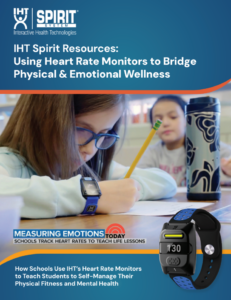
Heart rate is one of the earliest, most reliable physical indicators of rising stress, anxiety, or emotional escalation, often visible well before a behavior does. That’s the idea behind the Spirit System: a wrist-based heart rate monitor built specifically for K-12 use, paired with heart rate reporting and assessment software that turns real-time biofeedback into data that teachers, counselors, and IEP teams can actually use.
Here’s how schools are applying it directly to self-regulation IEP goals and IEP progress monitoring:
Individualized thresholds. Every student’s zones and goals can be set individually, which matters enormously for caseloads with widely varying physical, cognitive, and medical needs. A threshold that makes sense for one student may not make sense for another, and the Spirit System doesn’t force a one-size-fits-all setting. Learn how teachers use IHT to easily conduct testing and boost the confidence of adapted PE students.
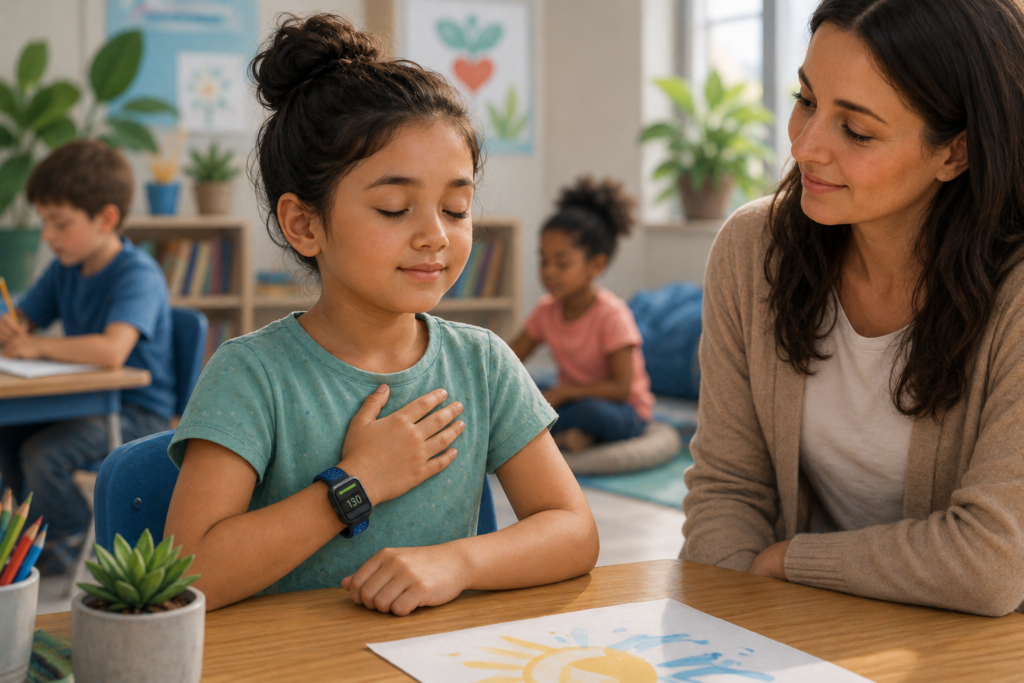
Early, visible warning signs. Students see their own zone in real time, right on their wrist, which gives even nonverbal or minimally-verbal students a concrete way to notice and communicate escalation before it becomes a crisis, directly supporting goals like the emotional self-regulation IEP goals listed above. Read about how adapted PE students use heart rate monitor feedback to self-manage their physical activity levels during class.
Low-lift data collection. Data syncs into apps and software automatically, removing the burden of paper tracking sheets or end-of-day memory recall, which matters for special education teachers, counselors, and adapted PE specialists managing large caseloads with limited documentation time.
Non-diagnostic, non-clinical framing. For counselors integrating this into Tier 1, 2, or 3 SEL supports, the monitors’ color-coded zones gives students a simple, non-shaming way to talk about their bodies and emotions, without ever feeling like a diagnostic tool.
For IEP teams building a case for funding, a program like this doesn’t need to replace existing supports … it strengthens the data behind them.
Interested in edtech funding strategies? Read the best tips and tricks from other educators.
Quick Answers: Self-Regulation IEP Goals and Progress Monitoring
How do you write a self-regulation IEP goal?
A strong self-regulation IEP goal names the specific behavior, the condition under which it should occur, a measurable target (frequency or percentage), and the method used to measure progress, such as observation logs, data collection sheets, or objective biofeedback data.
How is IEP progress monitoring different from a regular grade?
IEP progress monitoring tracks a student’s growth toward a specific, individualized goal over time, typically using consistent data collection methods rather than a single test or assignment, so the team can adjust supports based on actual trends.
What’s the difference between an emotional self-regulation goal and a behavior goal?
Emotional self-regulation goals typically focus on a student’s ability to recognize and manage their internal state (e.g., naming an emotion, using a coping strategy), while behavior IEP goals focus more directly on the observable action itself (e.g., remaining in an assigned area, following a direction).
Can heart rate data really help measure self-regulation progress?
Yes, heart rate is one of the earliest physiological indicators of rising stress or emotional escalation, often changing before any visible behavior does. Tracking heart rate patterns over time gives IEP teams an objective data point to pair with observational data, rather than relying on observation alone. There are many benefits of wearable technology in education, including reliable, quantifiable data collection that doesn’t depend on a student’s ability to self-report or an observer’s interpretation.
Is heart rate monitoring appropriate for nonverbal or minimally verbal students?
Yes, and it’s often especially useful for this population. Since heart rate monitoring doesn’t require a student to self-report how they’re feeling, it gives IEP teams and SPED educators a way to track escalation and regulation patterns for students who can’t reliably communicate their internal state on their own.
Ready to Bring Objective Data to Your Next IEP Meeting?
Self-regulation will always be one of the hardest skills to teach, and one of the hardest to measure. It doesn’t show up on a worksheet. It doesn’t have a right or wrong answer. It happens in the seconds between a trigger and a reaction, often in a place no one else can see. But that doesn’t mean it has to stay a guessing game.
Whether you’re an adapted PE teacher managing a caseload with wide-ranging needs or a school counselor trying to make the most of limited one-on-one time, the Spirit System is built to give you real, individualized data to support and enhance self-regulation IEP goals.
Request a custom quote and we’ll walk you through exactly how schools like yours are using heart rate data for IEP documentation, progress monitoring, and eligibility support.