When the Alief Independent School District spotlighted LaShonda Cameron in their Alief Staff Making a Difference series earlier this year, the recognition was long overdue.
Cameron, the Secondary Lead PE Teacher and Physical Educator at Kerr High School in Houston’s Alief Independent School District, Texas, has been integrating heart rate monitor technology into her PE program for more than 10 years. But it wasn’t until a critical challenge threatened her program that she had to get creative. And in doing so, she modeled exactly the kind of resourcefulness that other physical education teachers can learn from.
Keep reading to learn how a district-wide commitment to innovation, more than a decade of consistent program-building, and a well-written grant application to the Alief ISD Education Foundation came together to ensure that hundreds of students can continue learning from real-time heart rate data in PE class.
From Participation-Based to Data-Driven, Student-Centered Learning
More than 10 years ago, IHT’s heart rate monitors were introduced to Alief ISD high schools as part of a district-wide push toward innovation and meaningful classroom technology integration. At the time, wearable technology in education was becoming more mainstream, and PE teachers were beginning to recognize its potential to transform how students understood their own bodies.
“The challenge we were trying to solve wasn’t a lack of activity – it was a lack of understanding,” Cameron said. “Students were participating, but many didn’t fully grasp why certain activities mattered, how effort levels related to health outcomes, or how their bodies were responding in real time. The goal was to shift physical education from participation-based to data-informed, student-centered learning.”
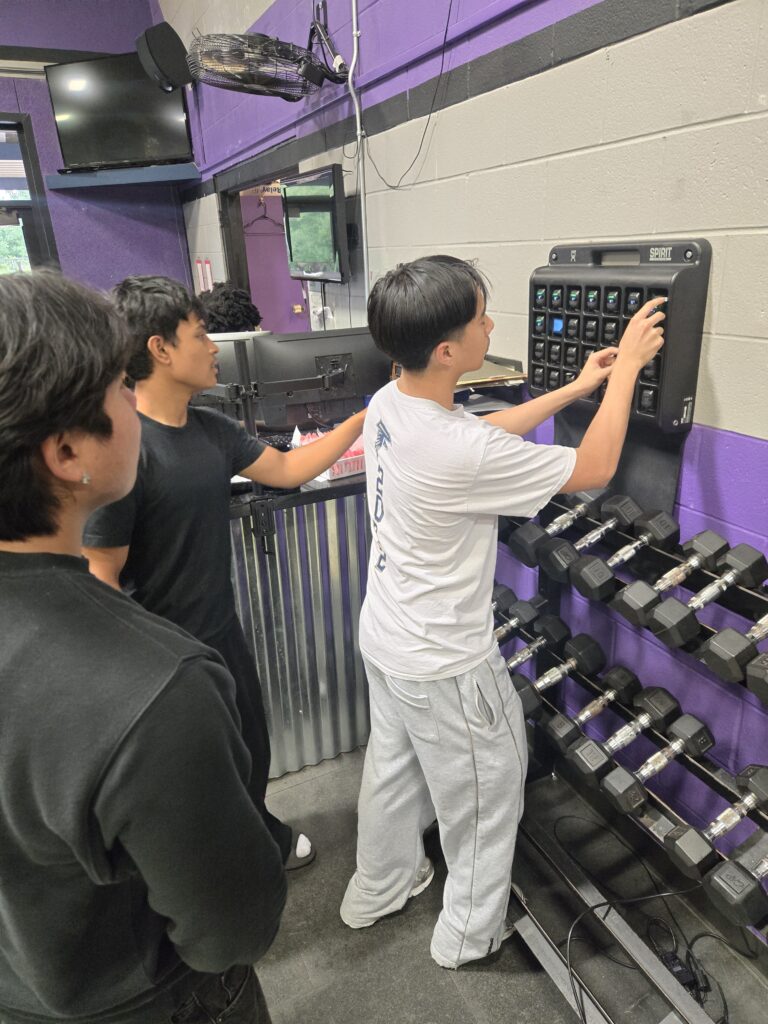
Today, all five Alief ISD high schools use our heart rate monitors, with hundreds of students interacting with the technology in their PE classes. Kerr High School is using the newest generation of IHT monitors called the IHT Spirit heart rate monitors.
⌚ Read more: What Are the Best Heart Rate Monitors for Schools?
The Power of Color-Coded Heart Rate Zones
Although Cameron was not directly involved in the original purchasing decision, she quickly understood why our heart rate monitors are so impactful and why they’re one of the best ways to monitor student wellness in schools.
Today’s students are immersed in all types of wearable technology. Cameron bridges this wearable technology familiarity with meaningful instruction, helping students understand how everyday technology can support their fitness, wellness, and long-term health. Students enjoy tracking their heart rate zones, comparing effort levels, and seeing how different activities impact their fitness.
“The color-coded heart rate zones and real-time visual feedback make complex physiological concepts accessible for all learners and allow students to immediately connect effort to personal health outcomes,” Cameron said.
That accessibility matters enormously in a high school PE setting, where students bring wildly different fitness levels, motivations, and relationships with physical activity into the gym. Heart rate zones remove the subjectivity. Students and PE teachers don’t have to guess whether they’re working hard enough – they can see it in real time.
📚 Learn more about how physical activity impacts academic performance.
The Missing Piece that Led to the Grant Application
Cameron’s program was thriving, but the hardware was aging. The heart rate monitors were more than 10 years old, and maintaining them was increasingly costly. So, the district provided Cameron with 56 new Spirit monitors.
However, one important piece was still missing: a tablet needed for the IHT Classroom App.
“The tablet is necessary to run the IHT Classroom App and display real-time student data and a much easier check out/in process,” Cameron explained.
When she came across the grant opportunity through the Alief ISD Education Foundation, she knew she had to apply. Through her determination and hard work, she was awarded the grant and was able to purchase a tablet.
“The IHT Classroom App has streamlined instruction by allowing real-time monitoring, efficient reporting, and stronger connections between instruction and outcomes,” she said. “It is designed with teachers in mind and supports daily classroom practice.”
How She Won the Grant & Advice for Other Educators
Cameron’s grant application tied her request directly to her teaching philosophy and to students’ long-term outcomes. The Alief ISD Education Foundation spotlighted her approach as a model for other educators in the district.
Her core philosophy is captured in a phrase she regularly shares with her students: “Your today determines your tomorrow.” Students who prioritize their well-being today build the foundation for a healthier tomorrow, and that’s exactly the kind of long-term impact that resonates with grant reviewers.
Her advice to other educators who want to pursue grant funding for a heart rate monitor program:
- Go for it. If the need is there, apply. The worst anyone can say is no.
- Look within your own district first. Many districts have education foundations or internal grant programs that PE teachers overlook.
- Value meaningful learning that students will carry with them, over what’s new and trendy.
- Connect your request to student outcomes, not just equipment needs. Reviewers want to see long-term impact of your program.
- Ask for support and embrace opportunities. Cameron credits the Alief ISD Education Foundation for bridging the gap between vision and reality.
💵 For more stories and practical tips on how educators have funded heart rate monitor programs, read our post on funding strategies for EdTech.
Teaching Students to Own Their Health and Their Data
What makes Cameron’s program stand out isn’t just the technology – it’s what she does with it. Her teaching philosophy is rooted in the belief that physical education is essential to academic achievement and student success.
For students who are not traditionally athletic, the data from our heart rate monitors is especially powerful.
“Heart rate monitors help students understand what productive effort feels like, build confidence, and take ownership of their learning,” Cameron said. “For many students, particularly those who are not athletically inclined, the data validates their effort and reframes their relationship with physical activity.”
Cameron’s program is meeting students where they already are and the results speak for themselves.
A Real Student Success Story: 25 Pounds and a New Relationship With Fitness
Perhaps the most powerful testament to Cameron’s program didn’t come from a report, but from a student who wanted to share his success story.
When he first came to Cameron’s class, he weighed 258 pounds. He has since lost 25 pounds and credits the Spirit heart rate monitors as a key part of that transformation. When Cameron asked what had contributed to the change, he explained that wearing the monitors and learning how to interpret the data made him take a deeper look at his health.
“He mentioned that seeing things like his heart rate helped him better understand what his body was doing during exercise,” Cameron explained. “He especially enjoys using the treadmill with incline settings because he can watch his heart rate increase and understand how his body is responding to the workout.”
He also shared something that speaks directly to the equity dimension of wearable technology in PE: he does not own a fitness tracker of his own. But having access to the Spirit monitors in PE class motivated him to dive deeper into his personal health journey and take his fitness more seriously.
Stories like this are exactly why Cameron does the work she does.
“I enjoy empowering students with knowledge about their bodies and health,” she said. “Teaching physical education allows me to impact students beyond the classroom by helping them build habits that support lifelong wellness.”
The Data Helps Teachers Too, Especially for TIA in Texas
Cameron is also clear-eyed about the professional value of the data the IHT Spirit System generates.
“The monitors allow me to teach objectively, differentiate instruction, and support assessment and grading with real data,” she said. “They also provide concrete evidence to advocate for my physical education program.”
In Texas, this kind of documented student growth also greatly benefits the teachers. Our IHT Spirit Assessment Software’s Student Growth Report gives educators the quantifiable data they need to demonstrate impact and student progress over time, especially for programs like the Teacher Incentive Allotment (TIA), which rewards top-performing educators with additional state funding based on demonstrated student growth.
In an era when PE programs face constant scrutiny over budget and instructional value, data is advocacy. It’s the difference between describing your program’s impact and proving it.
10+ Years of Success: What Sustained Implementation Looks Like
Longevity is rare in edtech. Most school technology programs cycle through tools every few years as budgets shift, staff change, or enthusiasm fades. Cameron’s program is the exception.
“The key to long-term success with this program has been consistent use, clear instructional purpose, student buy-in, and data-driven advocacy,” she said. “Educators interested in implementing similar programs should focus on sustainability and student understanding rather than novelty.”
That framing – sustainability over novelty – is something IHT hears from its longest-tenured customers again and again. The Spirit System is designed to grow with a student wellness program. Cameron’s consistent use of our monitors for over a decade is proof of what’s possible when the technology, the teacher, and the institutional support align.
💪 Read more: Teacher Relies on Heart Rate Monitors to Encourage Lifelong Physical Activity
Is Your PE Program Ready to Make the Jump to Data-Driven Instruction?
Cameron’s story is a successful blueprint, not just for grant writing, but for building a PE program that students, administrators, and parents can all get behind. Whether you’re starting from scratch or looking to expand what you already have, IHT’s Spirit System gives you the tools to make student effort visible, measurable, and meaningful.
The IHT Spirit Heart Rate Monitor and IHT Spirit Software Suite are built for exactly this kind of work, from the classroom to the district office (as well as for other types of youth organizations outside of education). And if funding is your first hurdle, our Funding & Grant Resources page is a great place to start.
If you’re an educator or district administrator ready to bring a heart rate monitor program into your school or expand a program you’ve already started, we’d love to talk.