
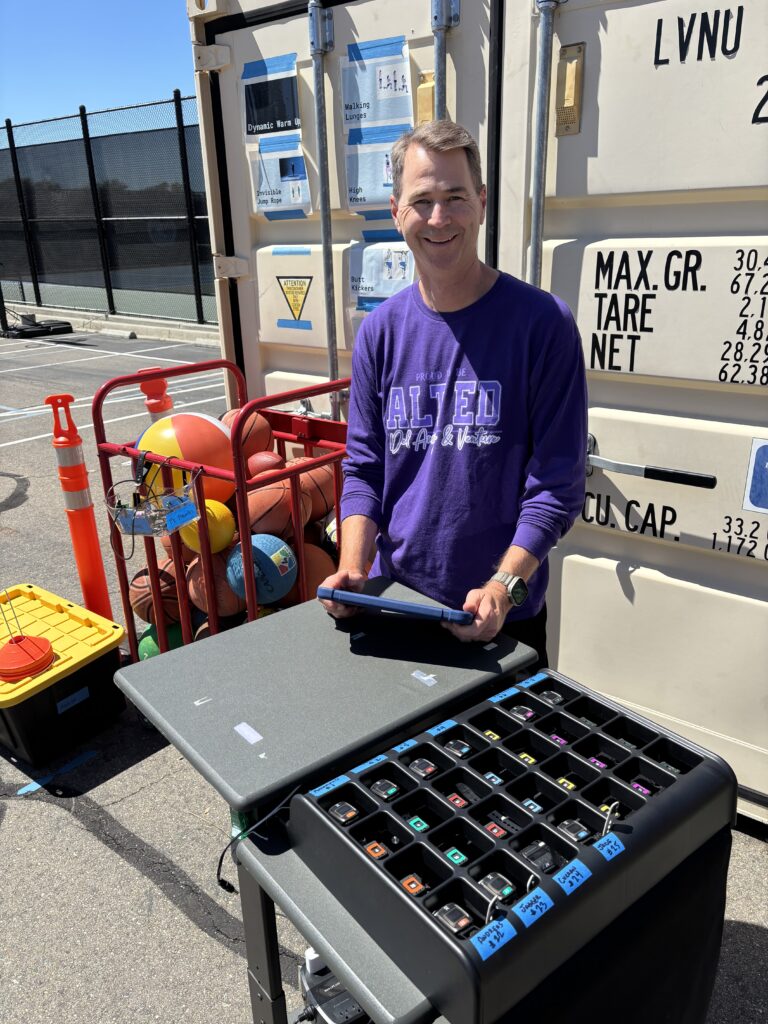
At Del Amigo High School, an alternative education and continuation school built around credit recovery, the students weren’t very motivated to participate in PE. At Venture Course-Based Independent Study, an alternative, online public school for students who thrive outside a traditional classroom, the challenge was finding a reliable way to ensure these online students were doing their assigned PE activities.
Two schools, two student populations, and two completely different types of PE classes.
That’s the challenge Eric Johnson, a former Fitbit program manager, faced as the Physical Education and Health Teacher at both schools in San Ramon, California. To reach both groups, he uses IHT heart rate monitors in two different ways.
Johnson already believed in the power of wearable data, but the consumer trackers he initially used for his students didn’t hold up. Students found ways to fudge the numbers, and he had no way to verify the data he was getting.
He needed heart rate monitors built for a classroom, not a consumer, and flexible enough to work as a motivational tool for both in-person PE students and virtual PE students.
Keep reading to learn how this PE teacher is using IHT’s student heart rate monitors to meet two very different groups of students exactly where they are, and what it has taught him about motivation, accountability, and heart health along the way.
From Fitbit to IHT: Why He Chose IHT Heart Rate Monitors
Johnson’s Fitbit background made him more particular than most about what a heart rate monitor needed to do. He already understood the value of wearable data. He just hadn’t yet found a tool built to hold up in a classroom.
The turning point came at a CAHPERD conference (the California Association for Health, Physical Education, Recreation, and Dance), where Johnson watched a presentation from Scott Smith, a PE teacher in the San Bernardino City Unified School District who had built an entire program around IHT’s heart rate monitors.
Johnson explained: “He’s been using them, and he’s like, ‘It changed my school around. We do PE, we need them, the kids are now self-motivated.’ They had a whole system.”
Johnson picked Smith’s brain about IHT’s heart rate monitors and Smith’s PE program and brought the idea back to his own district. After working through the privacy and data agreements his district required, Johnson received the approval to purchase the heart rate monitors for both schools he taught at.
Two features stood out to Johnson immediately: the color-coded zones and the ability to see student data after the fact.
“One of the best benefits of IHT is I have a dashboard; I can look at the data that the student has,” Johnson said. “That’s super important because I can validate and say, ‘Hey, you’re not doing it, let’s talk about your data.’ That’s hugely important, and that’s one of the big benefits of IHT.”
The color-coded zones offer a different kind of benefit: immediate feedback for students in the moment.
“I like the color bevel, blue, yellow, or red. A student can take a look at what zone they’re in. I like that immediate feedback. ‘Ok students, let’s get in the yellow, everybody, get in the yellow, let’s move it.’ That’s a very powerful thing.”
Read more: Why educators choose the IHT Spirit System.
In Her Own Words: A Venture Student on Using Exercise to Support Overall Wellness
One of the clearest examples of the monitors’ impact came through a student writing assignment, in which Venture students were asked to give advice to a new student joining the program. One student, who has managed anxiety throughout her time at Venture, wrote candidly about what the class had taught her about herself.
“In online PE, it may seem like a class to just slack off, but in reality, it really teaches you discipline and self-improvement,” she wrote. “More than the physical aspect, the importance of exercise in your daily life is highlighted. The most important part of exercising is the mindset. Being able to keep yourself accountable to complete workout assignments on your own time is a lot harder than it seems.
“Rather than dragging yourself to complete a workout solely for a grade, think about it as an opportunity to take time for your mental and physical health. Online PE gives you some flexibility, so you get your work done by doing something you enjoy, like a sport.”
Johnson said her reflection captures what he sees more broadly among his Venture students: students who came to the program without much interest in fitness leaving with a genuine understanding of how movement supports both their physical and mental health.
Using Heart Rate Monitors for Schools to Reach Reluctant Learners
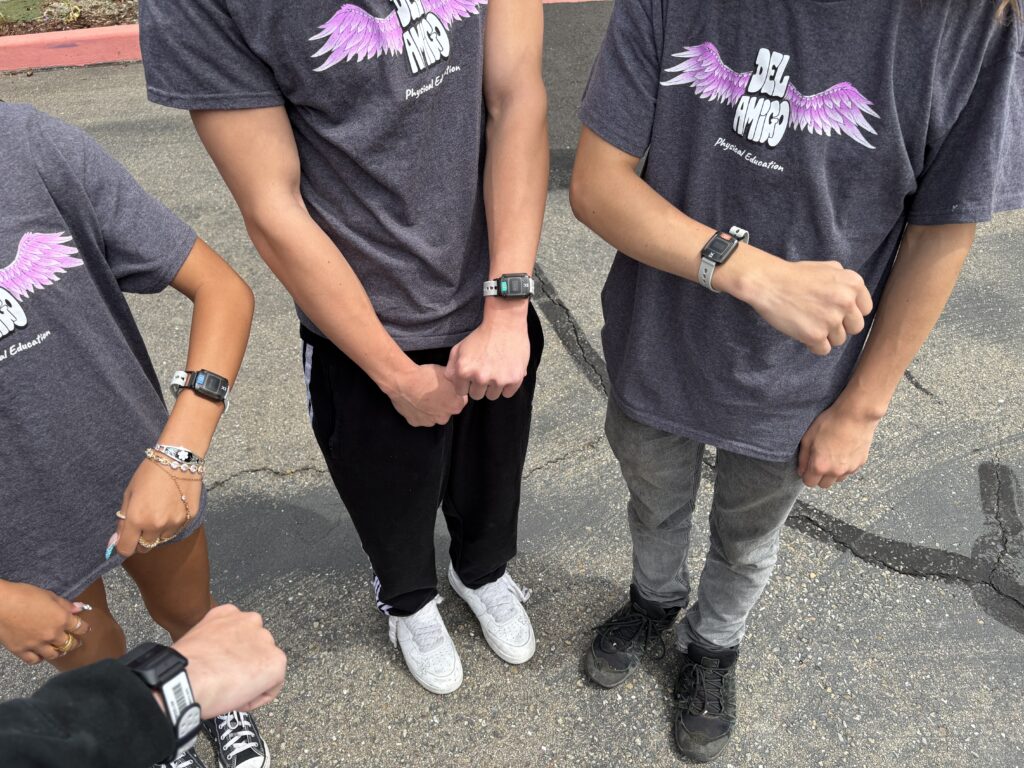
Roughly 50 Del Amigo students and 75 Venture students, all in grades 9 through 12, wear our heart rate monitors as part of Johnson’s PE classes.
At Del Amigo, Johnson meets with students four times a week for 45-minute sessions, with a heavier emphasis on flexibility than structure. Because students are constantly cycling in and out of the program as they recover credits by graduating and/or transitioning back to comprehensive schools, Johnson leans on the monitors for simpler activities: guided walks, individual workouts of the student’s choosing, and the occasional class-wide challenge.
“We’ll go up a hill. ‘How are you guys doing?’ And just talk about differences,” Johnson said.
One of his favorite formats has been a group challenge that starts small and builds over time.
“I had a climb-a-mountain challenge, where we started with zero MVPA minutes, and the next day two minutes, four minutes,” Johnson said. “We try to work our way up to 40 minutes every day.”
Even with a group that isn’t naturally enthusiastic about PE, Johnson said the data from the heart rate monitors gives him something to work with that he didn’t have before. And when a student wants to turn their grade around, he can point to their monitor data and build an assignment around exactly what they need.
“I have a couple students who really want to put the effort in, really want to get a better grade. I can give these assignments that are sort of individualized that I probably would not have in a traditional setup.”
Johnson also sees a bigger opportunity ahead for his Del Amigo students. Unlike his Venture classes, where in-depth conversations about fitness and health are built into sessions, his in-person Del Amigo PE classes don’t get as much of that classroom discussion time, something he’s hoping to change.
“That’s one thing I want to work on a little bit more next year,” he said. “Trying to get more Del students some knowledge that we have about fitness and health that they probably wouldn’t get.”
Using Heart Rate Monitors to Establish Accountability in Virtual PE
Since Venture students only meet with Johnson twice a week, in-person accountability isn’t an option. That’s the gap our heart rate monitors for virtual PE were built to close.
Johnson designed a 22-week program built around the monitors: students complete an assigned workout for homework, log their effort using their IHT heart rate monitor, and submit a written reflection alongside their data, all building toward a FitnessGram Pacer test around week 13.
“We did 22 weeks where they used their monitor to do a workout for homework,” Johnson said. “They choose what kind of workout they want to do, but they have to hit goals: 30, 45, 60 minutes of MVPA.”
During live class sessions, Johnson runs a short social-emotional check-in, a brief educational segment, and then a 15- to 30-minute workout, with students voting on the activity via a slide deck. Afterward, students rate their own perceived exertion, and Johnson checks that against the data on their monitor.
“If a person puts a 10, and I look at their data, and it’s not, I have a conversation,” he said.
Without the monitors, Johnson said that tracking effort in an online class would come down to the honor system, which didn’t work for his students. IHT’s heart rate monitors established accountability for the virtual PE students.
“I think it’s really just been like it’s a great accountability partner for them,” he said. “Now, I see the data. If I see a flatline, you’re not doing it. That’s the power I have and I think that allows students to know that I have that power, and that allows students to maybe put more effort than they probably would not have in an online class.”
Read More: Virtual PE Program Stays Connected Using IHT Heart Rate Monitors
Heart Rate Monitors Increase Motivation in PE, for Every Type of Student
Across both schools, Johnson has found that the monitors do more than track effort. They give students and Johnson, a shared, judgment-free language for talking about how their bodies respond to stress, movement, and rest.
That’s been especially true for students managing anxiety. Johnson recalled a Venture student who came to class visibly nervous and saw her elevated heart rate reflected immediately on her monitor.
“We put the monitor on, and they’re in yellow,” Johnson said. “If you have a lot of anxiety, this is a heart rate you can see. You could be anxious, and that’s okay. The question is, can you take a couple big breaths, try to see if you can get it down a little bit?”
Beyond individual moments like that one, Johnson also uses the monitors as an entry point for broader conversations about what actually influences a student’s heart rate – conversations that go beyond fitness and into general health awareness.
“I think a lot of students learn about their high heart rate, and I’m like, ‘Do you take caffeine? Do you do drugs?’” he explained. “Some things can impact your heart rate. So we talk about that.”
Those conversations also give Johnson a way to reframe what “normal” looks like for each student, rather than comparing kids against each other.
“If you have a [high resting] heart rate, you’re going to feel more tired than a person who’s maybe more in-shape,” Johnson said. “And it’s like, that’s okay, both of you guys are doing movement that’s going to benefit you.”
Johnson also uses the monitors to normalize the fact that every student’s resting heart rate, and every student’s response to exercise, is different, which he says helps take the pressure off students who might otherwise feel discouraged in a traditional PE setting.
“We all varied on our resting heart rate,” Johnson said. “So that’s another one that’s like, we all are different, and that’s okay.”
For students who have historically disengaged from PE, Johnson said the combination of real-time feedback and reporting data has been one of the most effective motivation tools he has used in his classroom.
The Real Payoff: Better Teaching for Every Student
Johnson’s biggest piece of advice is aimed at educators managing online or hybrid programs, where accountability is hardest to come by.
“For the online world, I found this as a game changer, really,” Johnson said. “I don’t know how you teach without it. How do you get accountability in an online world? With IHT, you are able to get them to see if they are or not. We have data. Data doesn’t lie.”
Whether you’re managing a traditional PE class, online PE, or a credit-recovery program, Johnson’s experience shows that the right heart rate monitors for schools can meet students where they are, increase student motivation and accountability, improve students’ knowledge about wellness, and give teachers the data they need to make every class count.
IHT’s Spirit System is built to support exactly this kind of work: real-time feedback, actionable data, and the flexibility to work across in-person, hybrid, and virtual PE programs. For teachers like Johnson, that means every student can work toward their own goals, and the teacher has the data to guide them.
“It makes me teach better,” Johnson said. “We can have individual goals for each student, and we can learn about that data, and we can grow together.”