Every teacher has watched it happen.
A student who was perfectly fine five minutes ago is suddenly shutting down, acting out, or completely unable to focus.
The trigger might be obvious (such as a hard test, a conflict with a classmate, a change in routine) or it might be invisible. Either way, by the time the behavior is visible, the student’s nervous system has already been in overdrive for a while.
The challenge isn’t identifying that a student is stressed. The challenge is giving students the tools to recognize stress in their own bodies before it escalates and then calm themselves down.
That’s exactly what heart rate data makes possible.
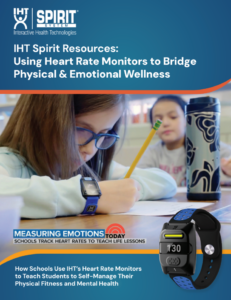
And it’s why more and more teachers and parents are turning to wearable heart rate monitors for emotional health and emotional regulation.
This blog post is a practical guide on how to teach stress management to students using real-time heart rate data, IHT’s color-coded heart rate zones that significantly help monitor student wellness, and a structured breathing framework called BREATHE.
Whether you’re a PE teacher, a school counselor, a social worker, a classroom teacher, or a parent/guardian, this approach gives you a concrete, science-backed method for teaching kids emotional regulation skills they’ll use for life.
Why Heart Rate Data Is the Missing Piece in Stress Education
Most stress management curricula for kids are built around concepts: identify your feelings, take a deep breath, count to ten. These are worthwhile ideas, but they have a significant limitation: they ask students to access abstract self-awareness in the exact moment when self-awareness is hardest. When a child’s stress response is activated, it can become harder to access the parts of the brain involved in reasoning, impulse control, flexible thinking, and communication.
This is how biofeedback emotional regulation changes everything.
Biofeedback means using real, objective data from the body (in this case, heart rate data) to help a person understand what’s happening inside them. Instead of asking a student to describe how they feel (which requires language, insight, and a calm nervous system), you show them what their body is doing in real time.
The IHT Spirit Heart Rate Monitor displays live heart rate data on the wrist in the form of color-coded zones. For students, this isn’t abstract. It’s live, in-the-moment feedback that the student can see and act on. The monitor’s screen changes color. The kids can feel the difference in their bodies. And that visibility is what makes teaching stress management to students through heart rate data so uniquely effective – it turns an invisible internal experience into something concrete and actionable.
Understanding Our 3 Heart Rate Zones
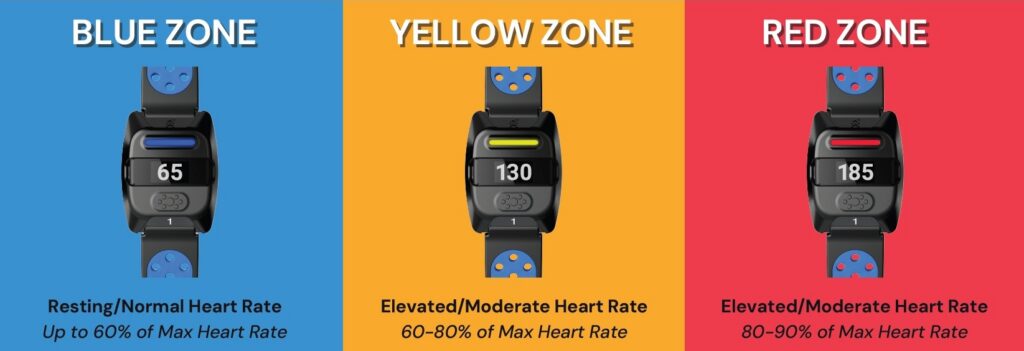
Before you can teach students to respond to their heart rate data, they need to understand what the colors mean – not just physically, but emotionally. Here’s how our three heart rate zones map to both physical effort and emotional state.
Blue Zone: Calm and Ready
The blue zone represents a low, resting heart rate.
Physically, this is where a student is at rest or engaged in very light activity.
Emotionally, blue typically means calm, focused, and regulated. This is the optimal state for learning, listening, and problem-solving.
For some students, blue may be where they begin the day or return after a successful regulation moment. For others, arriving at school may already bring stress, excitement, or elevated heart rate, which is why the color zones are most useful when paired with context and conversation. Blue is the baseline you’re always trying to help students get back to when stress spikes.
Yellow Zone: Active and Engaged
The yellow zone represents a moderate, elevated heart rate.
Physically, this is where students are during light to moderate exercise (a brisk walk, a warm-up, a game).
Emotionally, yellow can signal healthy engagement and energy, but it can also be an early warning sign of stress, anxiety, or frustration beginning to build.
Yellow is the critical intervention window. A student in yellow who is escalating toward stress hasn’t yet lost access to their thinking brain. This is the moment when a calm prompt, a breathing exercise, or a check-in can make all the difference, and when teaching stress management to students is most effective.
Red Zone: High Alert
The red zone represents a high, vigorous heart rate.
Physically, this is where students are during intense exercise (sprinting, jumping, giving maximum effort).
Emotionally, red can mean a student is in a full stress response: overwhelmed, dysregulated, or flooded with anxiety or anger.
A student in the red zone during a non-physical activity is sending a clear physiological signal: their nervous system is activated and they need support. This is not the moment for redirection, correction, or complex instruction. This is the moment for a structured, body-based intervention, which is exactly what our BREATHE framework provides.
Students can also learn to notice body signals that often show up with stress, such as a tight chest, warm face or ears, clenched fists, tight jaw, tense muscles, dry mouth, fast breathing, or sweaty palms.
Learn more: How does the Spirit Heart Rate Monitor improve student wellness?
What to Do When a Student Is in the Red Zone: The BREATHE Framework
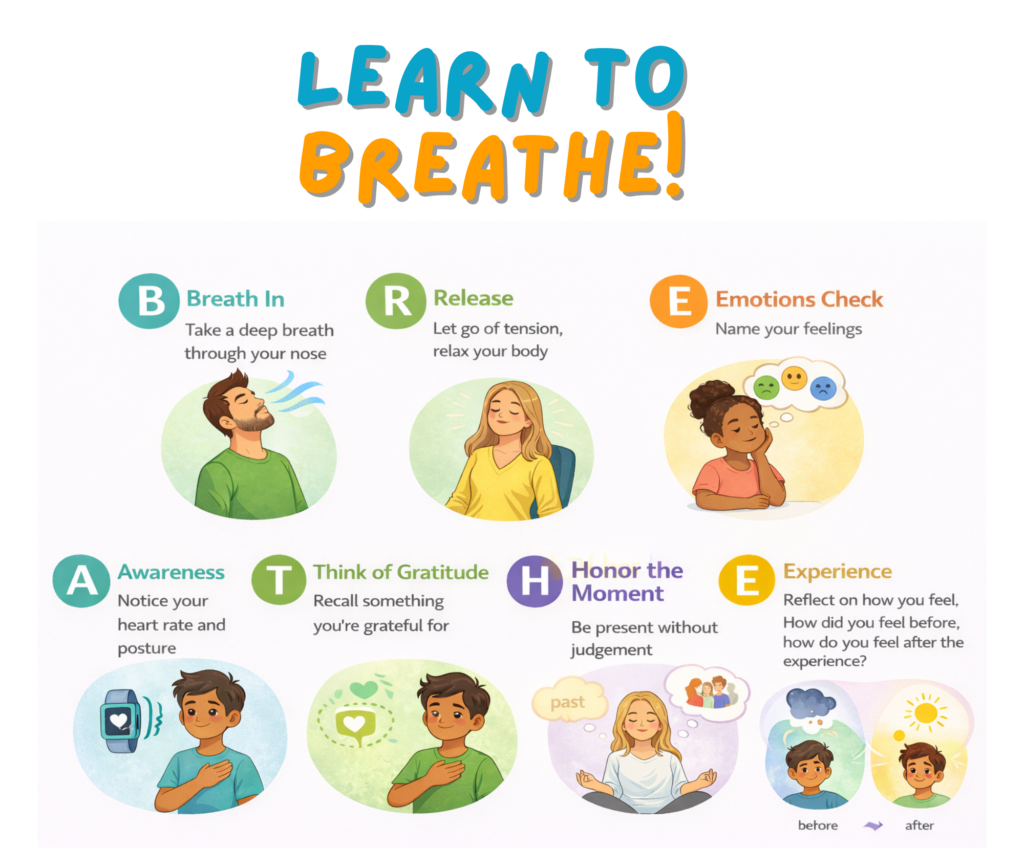
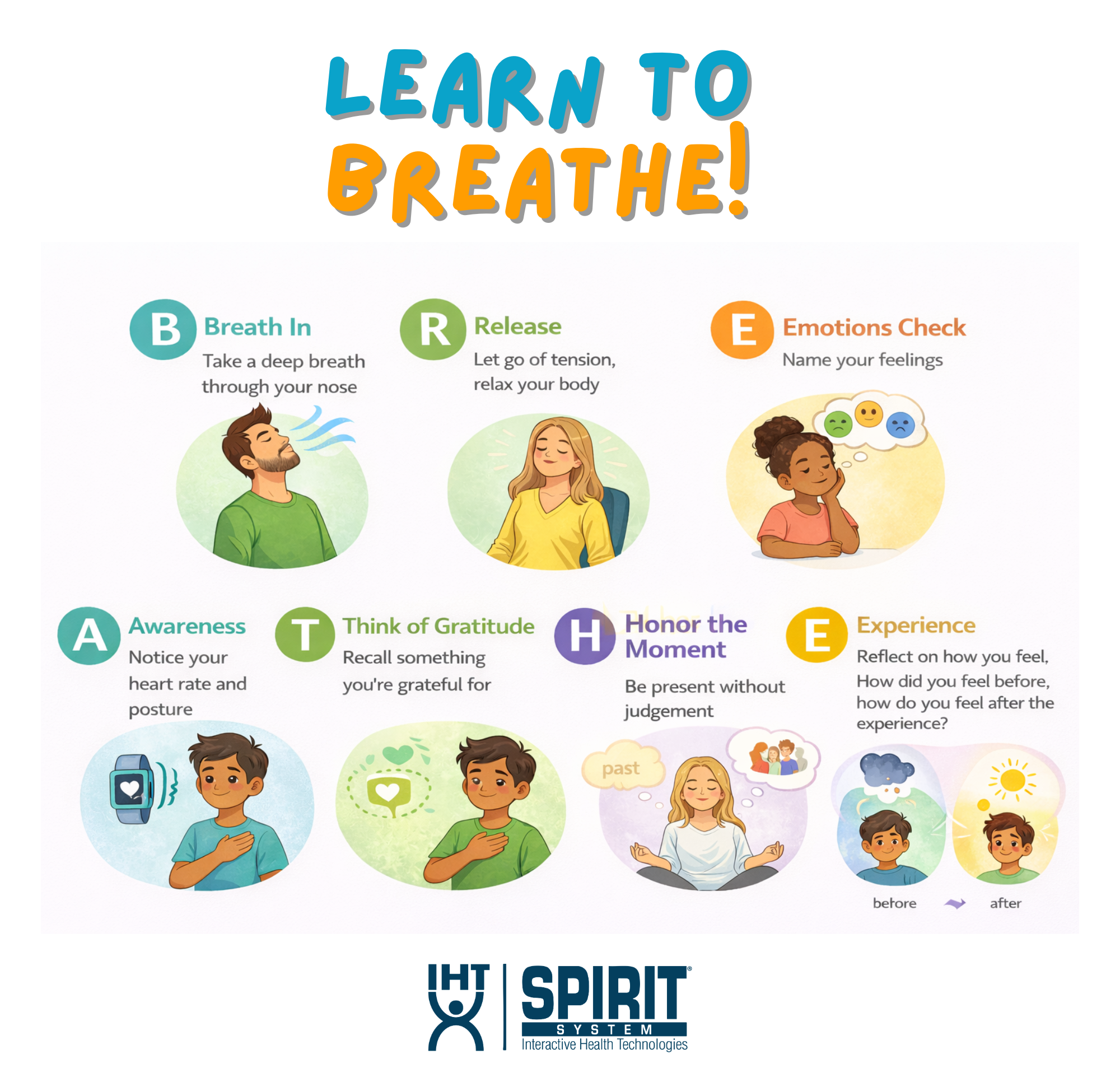
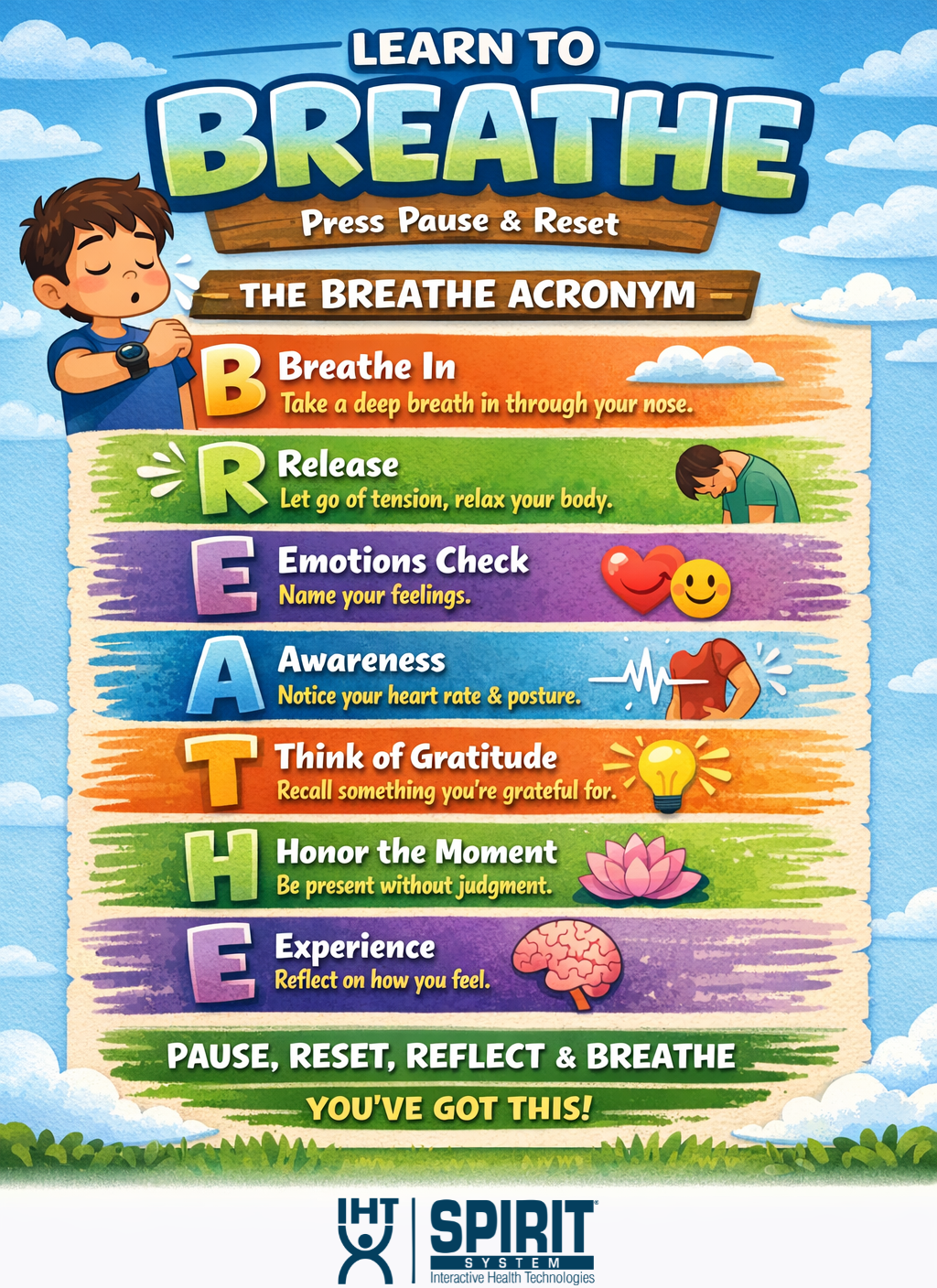
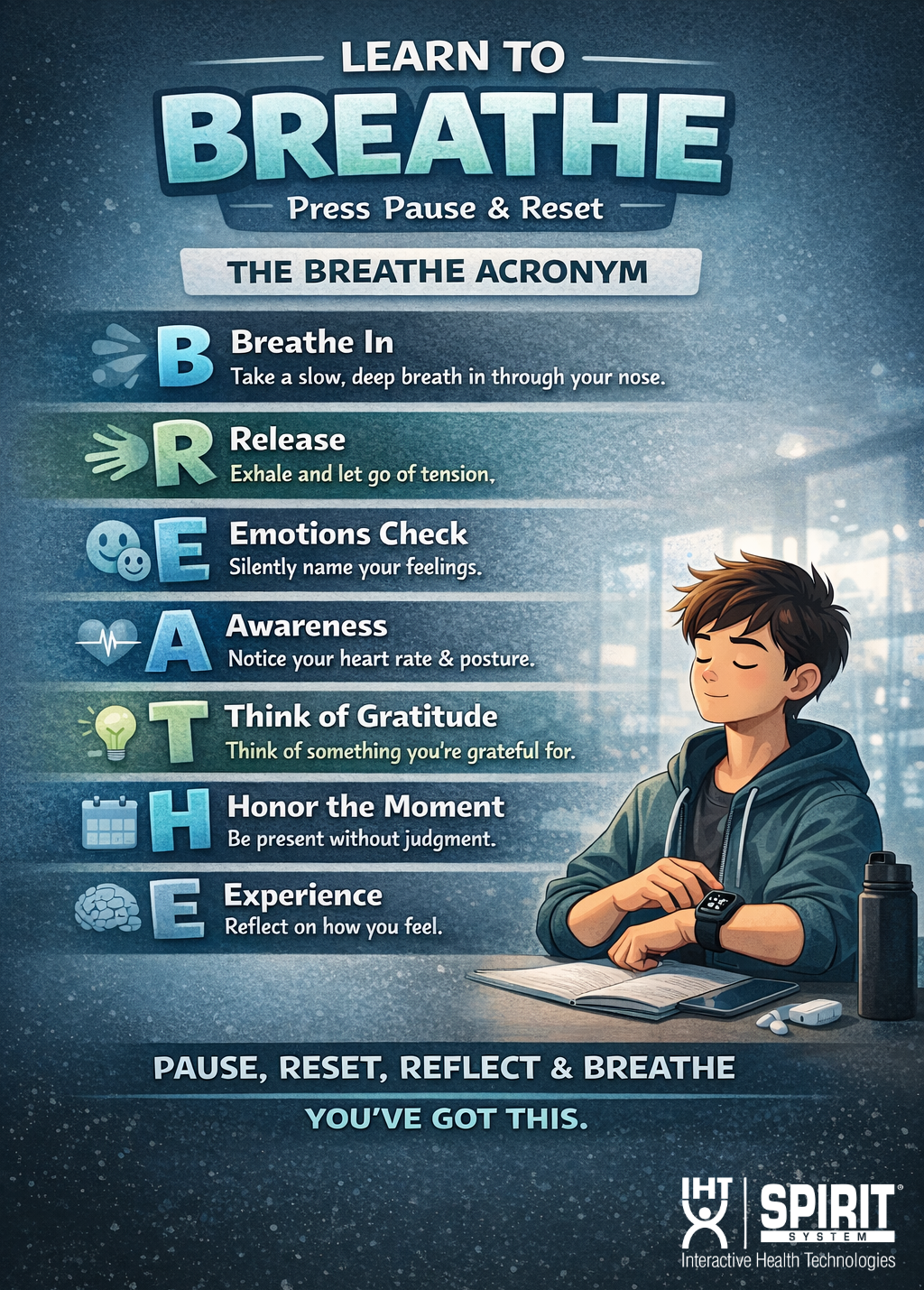
Our BREATHE acronym gives students (and the adults who support them) a step-by-step protocol for pressing pause and resetting when stress takes over. It’s designed to work from the body up, starting with breath and physical awareness, then moving into emotional naming and reflection. This sequence is intentional: you can’t think your way out of a stress response, but you can breathe your way through it.
Here’s what each step involves:
B – Breathe In. Take a deep breath in through your nose. This single action begins to activate the parasympathetic nervous system, signaling to the body that it is safe to slow down. Nasal breathing, specifically, has been shown to produce a calmer physiological response than mouth breathing.
R – Release. Let go of tension, relax your body. After the inhale, students consciously release physical tightness, such as unclenching fists, dropping shoulders, softening the jaw. Stress lives in the body, and releasing muscle tension is a direct way to interrupt the stress cycle.
E – Emotions Check. Name your feelings. This is the emotional labeling step, sometimes called “name it to tame it” in the neuroscience literature. Research on affect labeling suggests that putting feelings into words (such as angry, scared, embarrassed, overwhelmed) can help reduce emotional reactivity and support regulation.
A – Awareness. Notice your heart rate and posture. This is where the IHT heart rate monitor becomes a direct teaching tool. The student looks at their wrist, observes their heart rate zone, and connects their body’s data to their emotional experience. “I’m in red right now. That means my body is telling me I’m really stressed.” This step is the foundation of biofeedback emotional regulation: making the invisible visible.
T – Think of Gratitude. Recall something you’re grateful for. Research consistently shows that gratitude activates neural pathways associated with positive emotion and can interrupt rumination. For students, this doesn’t need to be profound (a pet, a friend, a favorite food). The point is to gently redirect the brain toward something positive.
H – Honor the Moment. Be present without judgment. This is a brief mindfulness step, an invitation to observe the current moment without labeling it as good or bad. For students who tend toward shame or self-criticism when they’re upset, this step is particularly important. You don’t have to feel good right now. You just have to be here.
E – Experience. Reflect on how you feel. How did you feel before? How do you feel after? This final step closes the loop by asking students to notice the shift and to recognize that the BREATHE process actually changed something in their body and mind. Over time, this builds the self-efficacy that is central to how to teach kids emotional regulation: the belief that “I have tools, and they work.”
⬇️ Download our BREATHE posters by clicking on the images below.
How to Teach Stress Management to Students: A Classroom Framework
Understanding the BREATHE steps is one thing. Integrating them into a consistent school-day practice is another. Here’s a practical approach for educators, parents, and any adults who support children who want to make this part of how they teach stress management to students every day.
Start with the zones, not the feelings. Before students can use BREATHE effectively, they need to understand the heart rate zones. Introduce the blue, yellow, and red zones explicitly. Post them in your classroom or counseling space, use them in language throughout the day. “I notice you seem like you might be moving into yellow. Want to check your monitor?” This normalizes the connection between physical state and emotional state without requiring a student to be vulnerable about their feelings first.
Build BREATHE into transitions. The most effective way to teach a stress management strategy to students is to practice it when they’re not stressed. Use BREATHE as a one- to two-minute transition routine between subjects, after recess, or at the start of a counseling session. When students have practiced the steps dozens of times in calm moments, they’re far more likely to access them in hard ones.
Use the monitor as a check-in tool. Rather than asking “How are you feeling?” – a question that can feel loaded or difficult to answer – try “Let’s look at your heart rate.” The data creates a neutral starting point. A student who is reluctant to talk about emotions may be very willing to observe and discuss what their body is doing. This is the power of biofeedback emotional regulation in a school setting.
Debrief after the reset. The final E in BREATHE (Experience) is also a powerful debrief tool. After a student has worked through a stressful moment, a brief reflection (“How do you feel now compared to five minutes ago? What did you notice?”) reinforces the lesson and builds self-awareness over time. Research on heart rate monitors and emotional wellness in schools consistently shows that this reflective practice is where the deepest learning happens.
Why This Approach Works: The Science Behind It
Teaching stress management to students through heart rate data is grounded in well-established science. Here’s why this approach is more effective than traditional verbal-only strategies.
The stress response is a biological event, not a choice. When a student is flooded with stress hormones, the prefrontal cortex (the part of the brain responsible for reasoning, impulse control, and empathy) goes partially offline. Asking a student in that state to “think about their behavior” is physiologically unrealistic. Body-based interventions like breathing and physical relaxation work with the nervous system rather than against it.
Biofeedback closes the gap between body and mind. Most children (and many adults) don’t have a clear sense of what stress feels like in their body until it’s already overwhelming. Wearable heart rate monitors make this process visible and learnable. Students who can identify “I’m moving into yellow” have a far larger window for intervention than those who only notice “I’m upset” after they’ve already escalated.
Consistent practice builds the skill. Emotional regulation is not an insight, it’s a skill, which means it has to be practiced. The BREATHE framework gives students a repeatable, structured sequence they can use independently over time. Every time a student successfully uses it, they build both the neurological pathway and the self-confidence that is at the heart of how to teach kids emotional regulation effectively.
The Spirit System: Built for Both Physical and Emotional Wellness
IHT’s Spirit System was designed from the ground up to support the whole child, not just their fitness, but their emotional health, self-awareness, and capacity for self-regulation. The Spirit Heart Rate Monitor’s color-coded zones make real-time heart rate data accessible to K-12 kids of any reading level. The Spirit Software Suite allows teachers, counselors, and administrators to track trends over time, identify students who may need additional support, and document the impact of wellness programming with real data.
Whether you’re a school counselor building a behavioral and mental health support program, or a parent/guardian wanting to support emotional wellness at home, the Spirit System gives you the tools to make it happen.
And with resources like the BREATHE framework built in, you don’t have to start from scratch. IHT has done the work of translating the science into something students can actually use in the moment, on their wrist, in real time.
If you’re ready to bring heart rate data and evidence-based stress management tools into your school, office, or home, we’d love to show you how the Spirit System works.