Michael Townsell was working in a hospital when the idea crystallized. As a Registered Respiratory Therapist and Pediatric Specialist, he had spent years watching children arrive in emergency departments with chronic illnesses – conditions that, in many cases, were tied to years of inactivity and a lack of health education.
“I got sick of seeing sick kids,” he said.
So he did something about it.
Townsell is the Founder and Executive Director of Generation Elev8, a non-profit youth wellness camp in Reno, Nevada, that exists to empower every generation to thrive physically, mentally, and emotionally through consistent daily practices rooted in movement, mindfulness, and community. He built it from scratch, while still working full time at the hospital. He staffed it largely with high school and college volunteers. He and his wife – a licensed clinical social worker – run it together while simultaneously taking care of their own children.
And somewhere in the middle of all of that, he stumbled across the impactful book “Spark” and everything about how he ran his camp shifted.
“This Is a Game Changer“
“Spark,” by Dr. John Ratey, makes the scientific case for how aerobic exercise ignites the brain and transforms learning, mood, and behavior. For educators, the most cited example in the book involves a school district in Naperville, Illinois, that used heart rate monitors in PE class to revolutionize student health and academic performance. It’s an impactful case study to all educators who read it. For Townsell, reading it was a moment he still remembers vividly.
“I actually remember the exact day I read it,” he said. “I was walking around and I was like, oh my gosh. This is a game changer. This is going to be a game changer for what I could do for these kids.”
The medical science wasn’t new to him. As a respiratory therapist, he already knew the relationship between heart rate, breathing, and the nervous system. He understood how slowing the breath slows the heart rate, how the heart rate reflects not just physical exertion but emotional state, how stress sends the body’s systems into overdrive. He lived that knowledge every day in the hospital.
What “Spark” gave him was a framework for applying it with children in a camp setting … and, most importantly, a specific tool to make it quantifiable: wearable heart rate monitors for kids’ camps.
The Search for the Right Product
Townsell is not the kind of person who buys something without researching it thoroughly. He spent years researching before he purchased a sauna for his home.
So, he tested a Garmin wrist monitor, Garmin chest monitor, and other monitors on himself before ultimately feeling unsatisfied with each option.
When he searched specifically for heart rate monitors for kids’ camp programs, IHT came up almost immediately.
“Divine intervention or not, you guys actually came up quickly,” he said. “I felt like I found you guys within the first, I don’t know, like 15 minutes of searching on the internet.”
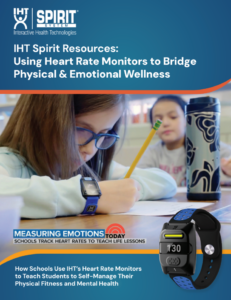
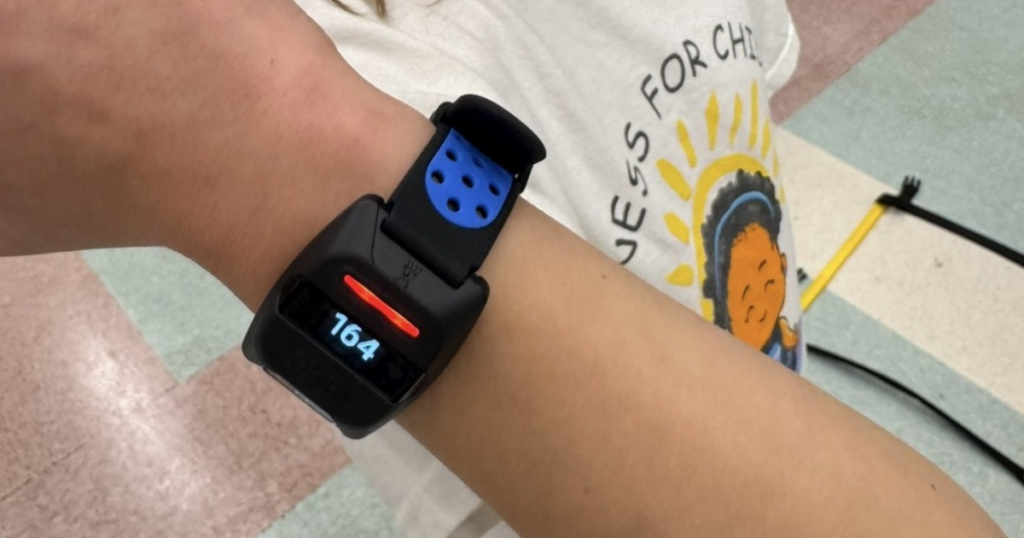
What he saw when he landed on IHT’s website stopped him in his tracks. The Spirit heart rate monitor’s color-coded heart rate zones displayed directly on the wrist monitor.
“I really liked the data,” he said. “I liked how you could put that heart rate monitor on, turn it on, hand it to the kid, do whatever you want throughout your class, the kid hands you it back, and all that data is stored. To me that is just like, it’s brilliant. It’s brilliant to show the kids their effort, it’s brilliant to show the parents.”
He called IHT, went back to his board of directors, and told them plainly: He was getting these monitors, one way or another.
“I don’t care if I have to take money out of my own pocket,” Townsell said. “I am getting these heart rate monitors because nobody really knows except you when it’s your own business.”
Generation Elev8 ran fundraisers, raised the money, and purchased 25 IHT Spirit monitors in September 2025. By October, the kids were wearing them.
💵 Interested in the Spirit System but not sure how to get the funding? Read this blog post for funding strategies.
Generation Elev8: Building Stronger, Healthier Kids
To understand why heart rate monitors for kids’ camp programs matter so much to Townsell and his holistic health camp, it helps to understand what Generation Elev8 is and what it’s filling in for.
Reno’s Washoe County does not fund physical education for kindergarten through eighth grade. Most schools don’t have a PE teacher. The standard, even in schools that do have some PE programs, is roughly 30 minutes of PE per week per class, if they’re lucky. Townsell estimates that only about 5% of schools nationwide have adequate PE programs, a statistic supported by national research.
Generation Elev8 exists, in part, because of that gap. Townsell even volunteered as a PE teacher at a local school for over a year (while working three jobs) just to give kids access to physical fitness.
At Generation Elev8’s camps, up to 50 kids attend each session, and camps run for about six hours. The activities are intentionally disguised as fun: ladder drills, box jumps, relay games, hiking, and yoga, all sequenced to maximize what the research calls the “learning window” that opens after physical activity.
“We go movement, learning, movement, learning,” Townsell said. After kids move, their prefrontal cortices are activated, neurogenesis is triggered, and the emotional health learning curriculum he layers on top – growth mindset, self-confidence, smart goal-setting – actually sticks.
He brings in yoga instructors from around Reno to teach kids how to match their breath to movement. He teaches them about the downstairs brain and the upstairs brain (drawing from the book “The Whole Brain Child”). He shows kids that when they get stressed or anxious, their heart rate rises, and that breathing can bring it back down.
“You will slow down your heart rate,” he said. “And when you get anxiety and you get all these feelings of stress, your heart rate will go up. So your heart rate’s not just about movement of the body. It’s also about the movement of your mind.”
The Moment He Knew: “Bingo“
Before introducing the heart rate monitors for kids’ camp sessions, Townsell tested them on his own children first. He’d been training his kids since they were young, and getting them to push themselves had always taken coaxing. The monitors changed that immediately.
“When I put those heart rate monitors on them, they were working out harder than they’ve ever worked out,” he said. “And right there, I was like, bingo. It wasn’t me pushing them, or, ‘Come on, you gotta go harder.’ It was literally them challenging themselves through trying to get their heart rate up, and the side effect was brilliant for me, because they were focused on their heart rate, I was focused on their performance, and it just made them perform at such a higher level. And that’s when I was like, oh yeah, these are golden.”
What Happens When You Put a Heart Rate Monitor on a Child
What Townsell has observed at his camps since the implementation of our heart rate monitors in October has consistently surprised him … and he’s someone who already believed in the product before he ever handed one to a camper.
The color zones hit differently than he expected. Kids are transfixed by them. They notice the subtle in-between colors as the monitor shifts from blue to yellow, from yellow to red. They compete – not with each other, but with themselves.
“I’ve never seen kids so excited to do the hardest workouts,” he said. “They’re like, what’s going to get my heart rate up the most? They just start doing burpees. They’ll just do burpees all day. And then in between drills, they’re doing high knees and running because they don’t want their heart rate to go down.”
One camper wore his Spirit monitor for five hours straight. He was in the yellow zone (moderate effort) for nearly four and a half of those hours. He spent almost a full hour in red. It even surprised Townsell.
But the impact isn’t limited to the naturally motivated kids. Townsell is explicit about who he’s trying to reach: the kids who aren’t into sports. The kids who are more isolated, more tech-oriented, less physically active. The ones who get discouraged when they can’t keep up with the fastest runner in the group.
“That’s our bread and butter,” he said. “That’s the kids that I want the most because they need the most help. And you will see these kids turn into triathletes.”
☎️ Have questions? Want a custom quote or a virtual demo? Let’s have a conversation at your convenience.
Removing Comparison From the Equation
One of the most powerful insights Townsell shared is about what the monitors do to the social dynamics of physical activity.
Every child who has ever reluctantly participated in PE knows the feeling: being slower than someone else, jumping shorter, running behind. That comparison is discouraging in a way that compounds over time. Townsell has watched the Spirit monitors dissolve that dynamic.
“It helps the individual kid focus on their own performance rather than competing or comparing themselves to other kids who might run faster, or jump higher, or do this better,” he said. “It keeps that comparison out of their minds because they’re only looking at themselves through their heart rate monitor.”
This was actually one of the things that first struck him in “Spark”: a kid who runs a 10-minute mile and a kid who runs a 7-minute mile might be putting in the exact same cardiovascular effort.
IHT’s heart rate monitors show that effort. For a child who has always felt like the “slow” kid, seeing objective proof that their effort is equal or greater is a revelation.
The Body-Brain Connection in Action
Townsell’s vision for the monitors extends well beyond fitness. He described a program he’s working toward: placing the heart rate monitors on kids with behavioral or disciplinary challenges throughout the school day to help them become aware of their own physiological state.
The idea is simple and profound. A counselor or social worker could pull up a child’s heart rate data at the end of the day and walk through it together. “You spiked right here – what was happening? Was this during the test? Were you anxious?” The data becomes a window into the child’s internal experience that words alone might never open.
“Using the heart rate monitor, you could track their day,” he said.
Townsell’s wife is planning to lead this component of their program. It’s the kind of use case that demonstrates exactly what IHT has always believed: that heart rate data isn’t just a fitness metric. It’s also a tool for emotional awareness, self-regulation, and whole-child wellness.
📊 Read more: How to teach stress management to students using heart rate data.
What the Parents Think of the Monitors
Parents haven’t been briefed yet on the full scope of what the Spirit System can show them. But they don’t need an explainer to know something is working. Their children come home and rave about the monitors. Parents have started asking where they can buy one for the house.
“I’ve had multiple parents where their kids come home and rave about these heart rate monitors, and now the parents want this specific heart rate monitor,” he said. “And they said they haven’t seen one like that that has the color [zones].”
Townsell is already directing parents interested in our heart rate monitors to IHT, and he’s planning to do a lot more of it. He’s currently fundraising to expand from 25 monitors to enough for all 50 kids in each camp session – and potentially more, as Generation Elev8 typically serves around 1,200 kids per year.
“You’ll Be Ahead of the Curve“
When asked what advice he’d give to anyone who is considering heart rate monitors for kids’ camp settings, schools, or at home, Townsell didn’t hesitate.
“I’d recommend [IHT] to anybody who works with children,” he said. “I couldn’t recommend it enough. And that’s from my medical background. It’s just going to make your program so much more evolved. And you’ll be ahead of the curve.”
He’s also candid about the fact that he estimates he’s only using about 30% of what the monitors and Spirit Software Suite are capable of and he’s already seeing this level of impact.
What strikes him, beyond the product itself, is the company behind it.
“I love your company,” he said. “People that are really in this for the right reasons. And I think that’s why your product turns out so well. God’s intervention put me right to your product because I was like, this is perfect.”
If you lead a youth wellness program, a non-profit, a camp, or any setting where children’s physical and emotional health is the mission – and you’re ready to see what heart rate data can do beyond the gym floor – we’d love to talk.